

M2P Fintech
Fintech is evolving every day. That's why you need our newsletter! Get the latest fintech news, views, insights, directly to your inbox every fortnight for FREE!
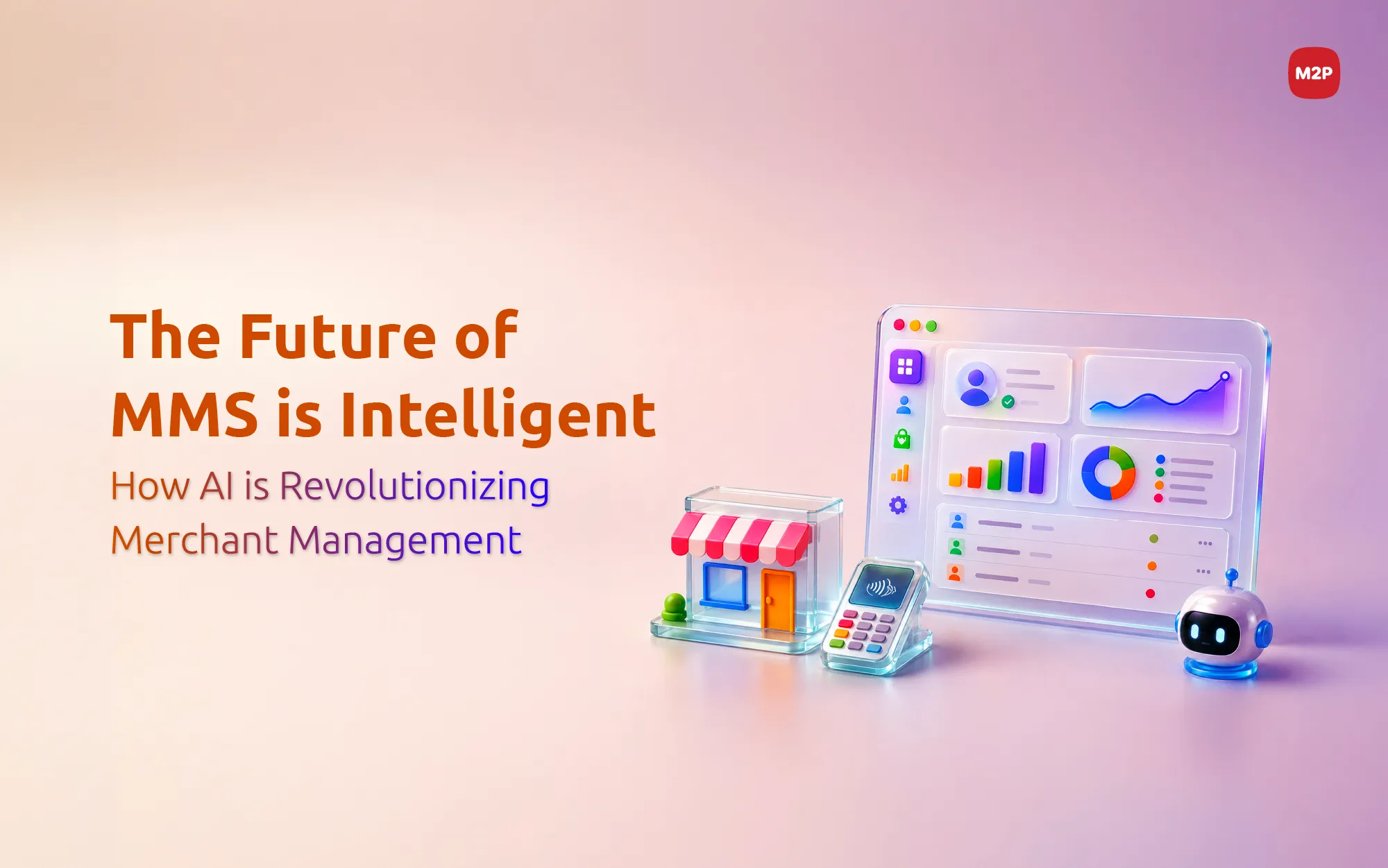
In the complex world of digital payments, the Merchant Management System (MMS) serves as the operational backbone for acquiring banks, payment processors, and merchants. These platforms are the central nervous system of commerce, managing everything from merchant onboarding to daily transactions. As the digital landscape evolves, a new strategic vision is emerging: a unified, AI-driven architecture set to revolutionize how these financial products are managed and deployed.
That's why we are thrilled to introduce a groundbreaking initiative: the Holistic MMS AI Platform. This isn't just an add-on or a simple chatbot; it's a comprehensive, "AI-native" operating system designed to be the single point of intelligence for everyone who interacts with MMS. Our vision is to create a seamless, proactive, and highly efficient service experience for our valued customers and our dedicated internal teams.
Before diving into the future, it's essential to understand the critical role an MMS plays today. At its core, an MMS is a software solution that automates and manages the entire lifecycle of a merchant account.
Merchant Onboarding & Know Your Business (KYB): This is the crucial first step where an MMS automates the application process, including document verification and robust KYB checks to confirm a business's legitimacy and comply with Anti-Money Laundering (AML) regulations. This can reduce onboarding time from weeks to just minutes
Account Management: Once onboarded, merchants get access to self-service dashboards to manage their accounts, view transaction histories, and track performance
Transaction Processing & Management: The MMS integrates with payment gateways to allow merchants to accept a wide array of payment methods, from credit cards to digital wallets. It provides real-time monitoring to detect anomalies and fraudulent activity
Settlement & Payout Management: The system automates the complex process of calculating fees and ensuring merchants are paid accurately and on time. It also manages different settlement cycles and helps handle disputes and chargebacks
Risk Management & Fraud Detection: A vital function is mitigating risk through real-time transaction monitoring to flag suspicious activities. Modern systems use a combination of rule engines and machine learning for continuous risk scoring
Reporting & Analytics: Powerful data dashboards provide deep insights into transaction volumes, approval rates, chargeback ratios, and revenue trends, empowering data-driven decisions
Our goal is to evolve from the current model to a centralized AI platform—the "MMS AI Brain"—that serves as the core of our information and task automation ecosystem. The vision is to shift from a fragmented, multi-vendor approach to a unified, modular stack where intelligence is the foundation, not an afterthought. This AI-native approach promises to deliver "systems of intelligence" capable of hyper-personalized journeys and automated operations.
The heart of this initiative is the MMS AI Brain, a centralized, generic AI agent platform. This platform moves away from monolithic, rule-based systems toward a more modular and intelligent architecture, analogous to microservices in modern software development.
This architecture is built on the concept of creating specialized "domain-trained agents" that can be plugged into the generic platform. This modular design offers incredible flexibility, scalability, and reusability. New features can be added by simply developing a new agent module without disrupting the entire system. These specialized agents, such as a Query Chatbot or a Support Ticket Auto-Resolution Agent, are created by "plugging in" specific components:
Data: Each agent is trained on a specific dataset relevant to its function. For example, a fraud detection agent would be trained on historical transaction data and known fraudulent patterns
Documentation & Policies: Agents are "grounded" in specific policy documents, product terms, and regulatory guidelines to ensure their actions are always compliant and consistent
APIs & Tools: Agents are given access to specific APIs and tools to interact with other systems, such as a CRM, a credit bureau, or a payment gateway, allowing them to execute tasks
An orchestration layer then manages the overall workflow, calling upon specific sub-agents as needed to handle complex, multi-step processes.
The power of this modular AI platform comes to life through its specialized agents. Let's explore the detailed capabilities of four cornerstone agents designed to revolutionize the merchant experience.
This AI agent acts as an interactive, 24/7 assistant for merchants, providing immediate answers and diagnosing issues that would traditionally require human intervention.
Merchants frequently ask "Where is my money?" (WISMO). The chatbot provides instant updates by integrating with various backend systems.
Operational Workflow: A merchant provides a transaction ID or order number. The chatbot uses Natural Language Processing (NLP) to understand the request and queries data sources via API in real-time. It then provides a clear status like "Approved," "Settled," or "Declined," and can even give shipping updates
Data Sources: Payment Gateway APIs, Order Management Systems (OMS), Enterprise Resource Planning (ERP) systems, and fulfillment provider APIs
Impact: This instantly answers 30-40% of all support tickets, eliminating wait times and freeing up human agents for more complex problems
Settlement reports are a common source of confusion. The AI chatbot can demystify them with data-driven explanations.
Operational Workflow: When a merchant asks why their payout doesn't match their sales, the AI analyzes their financial history, cross-referencing transaction data with their specific fee schedule. It can provide a detailed breakdown explaining discrepancies from refunds, chargebacks, and fees. Generative AI can even be used to create personalized settlement letters automatically
Data Sources: Settlement and reconciliation databases, transaction records, and the merchant's fee and contract database
Impact: This reduces confusion, disputes, and costly errors that would otherwise require manual investigation, thereby improving merchant trust and reconciliation speed
When a transaction fails, a quick diagnosis is crucial. The AI acts as a first-line diagnostic tool.
Operational Workflow: The agent retrieves the detailed transaction log, including the error code from the payment gateway. It cross-references this with a knowledge base and data from other systems to identify the root cause, such as a bank decline, a fraud block, or a merchant misconfiguration. It then provides a clear explanation and suggests actionable next steps
Data Sources: Payment gateway logs, real-time fraud and anomaly detection systems, internal system health dashboards, and the card issuer's response codes
Impact: This provides immediate insight into failures, allowing merchants to quickly resolve issues, prevent lost sales, and reduce escalations to technical support
This agent works behind the scenes to manage and resolve support tickets submitted via email or support portals, aiming to resolve issues autonomously or perfectly prepare them for human agents.
The first step to efficient resolution is proper classification.
Process: Using NLP and machine learning, the AI analyzes a new ticket's content to determine its category (e.g., "Billing," "Technical Issue"), sentiment, and urgency. It then automatically assigns a priority level and routes it
Impact: This automated triage replaces slow manual sorting, ensuring tickets are immediately organized and directed to the correct workflow, which reduces response times and prevents bottlenecks
Once classified, the agent acts as a virtual support agent to gather data.
Process: For a billing dispute, it might pull subscription details from the CRM, recent invoices from the billing system, and transaction data from the payment processor. This creates a single, unified view of the customer and the problem in seconds
Impact: This automated data gathering saves human agents significant time, allowing them to focus on problem-solving rather than searching for information across disconnected systems
For common issues, the agent can provide an immediate resolution.
Process: The agent searches the internal knowledge base, historical ticket data, and technical documentation for a solution. Using generative AI, it can craft a clear, personalized response and, for high-confidence cases, resolve the ticket from start to finish without human intervention
Impact: This can automate up to 60% of routine inquiries, significantly reducing the volume of tickets requiring human attention, lowering cost-per-ticket, and boosting first-contact resolution rates
The AI is designed to know when to escalate to a human expert.
Process: When an issue is too complex, involves a sensitive complaint, or is a repeat contact, the AI escalates it to the appropriate team. Crucially, it packages a full contextual summary including the original query, all data gathered, troubleshooting steps taken, and a summary of the issue
Impact: This seamless handoff ensures human agents have all necessary information from the start. It eliminates the need for merchants to repeat themselves and allows agents to begin resolving the problem immediately, dramatically reducing the mean time to resolution (MTTR) and improving the overall merchant experience
This AI agent transforms the static MMS dashboard into a dynamic, interactive environment, acting as an intelligent partner for users. It operates as an intelligent layer over the dashboard, using a conversational interface and proactive prompts to guide users
For new users, a feature-rich dashboard can be overwhelming. This AI helper acts as a personal guide to provide a dynamic and personalized learning experience
Operational Workflow: Upon first login, the AI analyzes the user's role (e.g., administrator, analyst) to create a customized onboarding plan. It initiates interactive product tours with checklists, spotlights, and embedded videos instead of a one-size-fits-all tutorial. The system also automates administrative tasks like scheduling training and tracks the user's progress through onboarding milestones
User Interaction: A new user can ask questions in natural language, like "How do I add a new product?" and receive immediate, guided answers. The AI might proactively check in, asking "Need any help with the project management tool?"
Impact: This personalized, hands-on approach significantly shortens the time it takes for new users to become proficient. Studies show AI-driven onboarding can reduce onboarding time by 50-53% and help new hires become fully productive 50% faster
Many powerful MMS features go unused because users are unaware of them. The AI helper acts as a proactive discovery tool to surface these functionalities.
Operational Workflow: The AI continuously analyzes user behavior to identify patterns, friction points, and underutilized features that align with their workflows. Based on this analysis, it predicts what a user is trying to achieve and proactively suggests relevant features through targeted, personalized "nudges"
User Interaction: A user might see a contextual pop-up stating, "I noticed you often export sales data. Did you know you can create and schedule customized reports directly? Would you like me to show you how?" . The dashboard could also feature a "Recommended for You" section with suggested features tailored to the user's activities
Impact: By intelligently recommending features at the moment of need, the AI lowers the barrier to discovery and learning. This leads to a direct increase in feature adoption, with one SaaS company seeing a 30% rise within the first week of implementing a similar AI tool
Setting up complex functions like tax rules, shipping zones, or payment gateway integrations can be a major hurdle . The AI helper simplifies these intricate processes by acting as a "wizard".
Operational Workflow: The AI breaks down a complex configuration into a series of simple, manageable steps. It can even use specialized AI agents trained on specific domains (e.g., security, data compliance) to handle parts of the process. At each step, it provides context-aware guidance and pre-fills information based on the user's profile
User Interaction: A user can start by saying, "I need to set up shipping rules". The wizard then asks a series of plain-language questions, turning a frustrating task into a straightforward, guided conversation. Some advanced systems even offer a low-code environment for users to create their own custom AI agents for specific tasks
This capability empowers users to build custom reports without needing to understand complex query languages, making data analysis accessible to everyone.
Operational Workflow: The AI uses natural language querying to translate a user's plain-text request (e.g., "Show me my top-selling products last month") into a structured database query. It can pull data from multiple sources and automatically select the best visualization—like a chart or graph—to present the data clearly. Some versions can even generate narrative summaries of the data
User Interaction: A user can simply ask the helper, "Show me a comparison of sales for Product A and Product B over the last quarter, broken down by region". The AI generates the report, and the user can ask for iterative refinements, such as "Now, can you break that down by payment method?". Users can then export or schedule the report to be run automatically
To accelerate developer onboarding and streamline the often complex process of system integration, we are developing a specialized AI agent designed for technical users. This Configuration Assistant and Implementation Guide acts as a centralized, interactive resource for developers, providing tailored guidance from initial setup to post-launch troubleshooting.
This agent transforms static API documentation into a dynamic, conversational experience.
Operational Workflow: Developers can access the assistant through a dedicated portal or directly within their Integrated Development Environment (IDE). They can ask questions in natural language, such as "How do I authenticate a user?" or "What are the required parameters for a transaction lookup?". The AI searches the entire knowledge base, including OpenAPI specifications and guides, to provide a precise answer. It can then generate ready-to-use code snippets in the developer's preferred language, which can be customized with their API keys for immediate testing. Developers can even ask for iterative refinements, like "Now add error handling for invalid input"
Impact: This "AI coding partner" approach accelerates the learning curve, reduces the likelihood of errors, and dramatically shortens development time by reducing the need to manually search through lengthy documents
The assistant acts as a virtual expert, offering best-practice recommendations to ensure a secure, compliant, and efficient setup.
Operational Workflow: As a developer configures their system, the AI monitors their choices and provides real-time suggestions. For example, it might recommend enabling specific encryption standards for security. The agent is trained on regulatory requirements like PCI DSS and will flag any configuration that could lead to non-compliance, suggesting a corrective action. It can also recommend configurations that optimize for transaction speed, cost, or approval rates by suggesting the best payment routing paths
Impact: This proactive guidance helps prevent common setup errors and ensures a more robust, secure, and optimized integration from the start, enhancing the quality of the entire payment ecosystem
A critical part of integration is testing in a secure sandbox environment, and the AI assistant streamlines this process significantly.
Operational Workflow: Based on the developer's implementation, the AI can automatically generate a comprehensive suite of test cases covering common scenarios, edge cases, and potential failure points. The assistant can then orchestrate the execution of these tests in an isolated sandbox that can mirror production integrations with platforms like Stripe, Shopify, and Salesforce, without affecting live data. The AI validates the results, confirms API calls are structured correctly, and highlights any discrepancies or failures for review
Impact: This automated testing and validation ensures the integration is robust before going live, catching errors early in the development cycle and preventing costly rework later
When errors inevitably occur, the AI acts as a powerful debugging partner, capable of analyzing code and logs to quickly pinpoint the root cause.
Operational Workflow: A developer can submit an error message, relevant code snippets, and log files to the assistant. The AI analyzes this information, correlates events across different services, and identifies patterns that point to the root cause, such as malformed API requests or authentication failures. It then presents a diagnosis and suggests a specific fix, often providing the corrected code directly. Some advanced versions may even have "self-healing" capabilities to automatically adjust test scripts when an API changes
Impact: This dramatically reduces time spent on debugging. By empowering developers to resolve issues independently, this capability is expected to deflect a significant volume of technical support tickets—potentially 60% to 80%—freeing up human agents for more complex escalations
The "Holistic MMS AI Platform" represents a significant leap forward in how we serve our customers and empower our employees. This initiative builds on the foundational role of the Merchant Management System (MMS) by introducing a unified, intelligent, and highly adaptable AI-native infrastructure.
The core of this strategy is the "MMS AI Brain," a modular AI platform that enables the rapid development of specialized agents. This report details four key agents: the Query Chatbot/Diagnostics Expert, the Support Ticket Auto-Resolution Agent, the Dashboard Navigation Helper, and the Configuration Assistant & Implementation Guide.
The Query Chatbot acts as a 24/7 frontline specialist for merchants. It leverages real-time data integrations to instantly answer questions about transaction status, explain complex settlement reports, and diagnose transaction failures, dramatically speeding up issue resolution
The Support Ticket Auto-Resolution Agent works in the background to automate the entire support lifecycle. It uses AI to classify tickets, independently investigate issues by gathering data from multiple systems, provide instant answers for common problems, and deliver seamless, context-rich escalations to human agents for complex cases
The Dashboard Navigation Helper serves as an interactive co-pilot within the MMS dashboard. It transforms the user experience by providing personalized onboarding guides, proactively discovering and teaching underutilized features, simplifying complex configurations through conversational wizards, and enabling non-technical users to build custom reports using natural language
The Configuration Assistant and Implementation Guide serves as an AI co-pilot for developers. It streamlines technical integration by providing interactive API documentation, best-practice configuration advice, automated sandbox testing, and intelligent debugging of code and logs. This significantly reduces implementation time and technical support tickets
For customers, this means 24/7 access to an intelligent assistant that provides instant, accurate answers and proactive support. For our employees, these AI agents act as powerful co-workers that automate repetitive tasks and provide the necessary context to solve complex problems efficiently. This strategic investment is set to revolutionize the MMS experience, making our services more efficient, accessible, and responsive for everyone.
Ready to lead the future of merchant acquiring? Book a demo with M2P Fintech and explore how our AI-native MMS helps you scale smarter, faster, and more securely.
Fintech is evolving every day. That's why you need our newsletter! Get the latest fintech news, views, insights, directly to your inbox every fortnight for FREE!