

M2P Fintech
Fintech is evolving every day. That's why you need our newsletter! Get the latest fintech news, views, insights, directly to your inbox every fortnight for FREE!
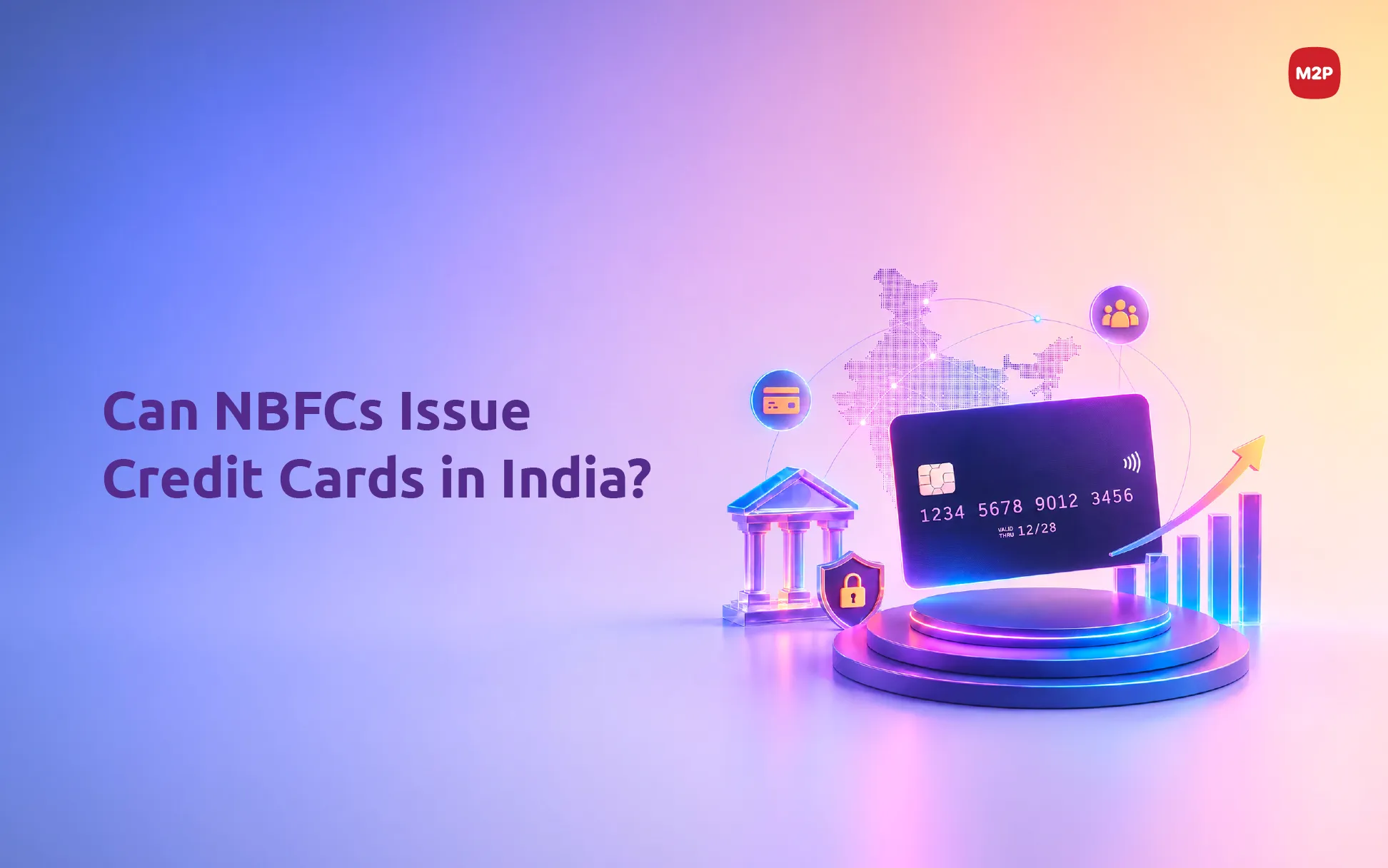
NBFCs have been expanding into consumer lending for years, and credit cards are the natural next step for many of them - deeper customer engagement, richer transaction data, and a recurring revenue line instead of a one-time loan. Credit cards are also one of the more heavily regulated products a lender can offer, which is why the question comes up almost every time an NBFC's product or strategy team starts scoping a card program: is this actually allowed, and if so, under what conditions?
RBI's Master Directions on Credit Card and Debit Card Issuance do allow eligible NBFCs to issue credit cards - either independently, or through a co-branded partnership with a bank. The word "eligible" carries most of the weight in that sentence, and it's where most of the confusion in this space actually starts.
E-commerce spending and rising card penetration in Tier-II and Tier-III cities have made unsecured digital credit a genuinely large and still-expanding market - outstanding credit cards in India stood at roughly 119 million, with monthly spends of around ₹1.97 trillion as of April 2026 (Source: RBI ATM & Card Statistics, as reported by Business Standard, May 2026). NBFCs, with distribution reach that many banks don't have in these geographies, are a natural fit to serve it - provided they can clear the regulatory bar to actually issue a card.
NBFCs were historically kept out of card issuance without specific RBI permission. That changed with the current Master Directions, which lay out a structured path for eligible NBFCs to issue credit cards, either as the primary issuer or through a co-branding arrangement with a bank. What "eligible" actually requires is where most NBFCs need to start.
Minimum Net Owned Fund (NOF). RBI requires NBFCs to hold a minimum NOF of ₹100 crore, along with prior RBI approval, to be eligible for independent credit card issuance (Source: RBI Master Direction – Credit Card and Debit Card – Issuance and Conduct Directions, dated April 21, 2022, as updated March 7, 2024).
Prior RBI approval. An NBFC cannot begin issuing credit cards on its own initiative - explicit prior approval from RBI is required before launch.
Board-approved policy. A public, board-approved policy covering issuance, pricing, and conduct must be published on the issuer's website.
No unsolicited cards or upgrades. Issuing a card, or upgrading an existing one, without the customer's explicit consent is prohibited and penalized.
Transparent billing. Interest rate ceilings must align with other unsecured lending products, and billing statements must be dispatched without delay.
Not every NBFC will meet these conditions on its own, which is exactly why the co-branded route (below) exists as a practical alternative for most.
Independent issuance means the NBFC meets RBI's eligibility criteria directly and issues cards under its own licence. This gives full control over the product and economics, but it also means owning the full compliance, capital, and infrastructure burden alone.
Co-branded issuance means a bank acts as the primary card issuer, handling the regulatory and capital-heavy side, while the NBFC brings its brand, distribution, and customer base. This is the faster, lower-friction route for NBFCs that don't yet meet the independent eligibility bar, or simply want to test the market before committing to a full build.
Most NBFCs entering this space for the first time start with a co-branded model and consider moving toward independent issuance later, once volume and eligibility support it.
Banks often apply fairly conservative, standardized criteria when evaluating creditworthiness. NBFCs typically have more flexibility to serve customers who fall outside those criteria - which means access to a segment that's underserved, not unqualified.
Beyond the lending itself, a credit card is a data asset. Every transaction gives an NBFC a clearer picture of a customer's spending behavior, which feeds directly into better-targeted lending and cross-sell decisions down the line. A card also creates a recurring reason for the customer to stay engaged with the NBFC, rather than a one-time loan relationship.
None of the above is free. Running a card program means handling real-time fraud monitoring, automated billing cycles, and customer support that can hold up under RBI's grievance-redressal timelines. As one example, closure requests from customers must be honored within 7 working days, and issuers who miss it face a penalty of ₹500 per calendar day, payable to the customer until the account is closed (provided there are no outstanding dues) (Source: RBI Master Direction - Credit Card and Debit Card - Issuance and Conduct Directions, dated April 21, 2022, as updated March 7, 2024).
This is the part that trips up new entrants - not the strategy, but the day-to-day compliance and infrastructure load that comes with actually running a card program at scale.
Can an NBFC issue a credit card without partnering with a bank? Only if it meets RBI's independent-issuance eligibility criteria, including the NOF threshold and prior approval. Many NBFCs start with a co-branded model instead, since it doesn't require meeting the full independent eligibility bar.
Is RBI approval required even for a co-branded card program? Yes. RBI's guidelines on co-branded cards apply regardless of which entity is the customer-facing brand - approvals and compliance obligations don't disappear just because a bank is the primary issuer.
What's the fastest way for an NBFC to launch a credit card program? In practice, a
co-branded partnership combined with a ready-built card management platform is typically the fastest route, since it avoids both the independent-eligibility hurdle and a multi-year technology build.
The regulatory path is clearer than it used to be, and the market demand isn't in question. Whether an NBFC pursues independent issuance or a co-branded partnership largely comes down to where it stands on RBI's eligibility criteria today, and how much of the compliance and infrastructure load it wants to own directly versus share with a bank partner.
The technology and compliance layer tends to be the deciding factor in how fast this actually happens. M2P's Credit Card Stack is built to support NBFCs through either route - independent or co-branded handling the underlying issuance, compliance workflows, and lifecycle management so the launch timeline depends on strategy, not infrastructure. Talk to us about what launching this would look like for your NBFC.
Can an NBFC issue a credit card without partnering with a bank? Only if it meets RBI's independent-issuance eligibility criteria, including the minimum Net Owned Fund requirement and prior RBI approval. Many NBFCs start with a co-branded model instead, since it doesn't require meeting the full independent eligibility bar.
What is the minimum Net Owned Fund (NOF) required for an NBFC to issue credit cards independently? RBI requires a minimum NOF of ₹100 crore, along with prior RBI approval, for an NBFC to be eligible to issue credit cards independently, as per the Master Direction on Credit Card and Debit Card – Issuance and Conduct.
Is RBI approval required even for a co-branded card program? Yes. RBI's guidelines on co-branded cards apply regardless of which entity is the customer-facing brand — approvals and compliance obligations don't disappear just because a bank is the primary issuer.
What's the difference between an NBFC issuing a card independently versus through a co-branded partnership? Independent issuance means the NBFC holds the licence, meets RBI's eligibility criteria directly, and owns the full compliance and capital burden. In a co-branded arrangement, a bank acts as the primary issuer and carries that regulatory and capital load, while the NBFC contributes its brand, distribution, and customer base.
What's the fastest way for an NBFC to launch a credit card program? In practice, a co-branded partnership combined with a ready-built card management platform is typically the fastest route, since it avoids both the independent-eligibility hurdle and a multi-year technology build.
Fintech is evolving every day. That's why you need our newsletter! Get the latest fintech news, views, insights, directly to your inbox every fortnight for FREE!