

M2P Fintech
Fintech is evolving every day. That's why you need our newsletter! Get the latest fintech news, views, insights, directly to your inbox every fortnight for FREE!
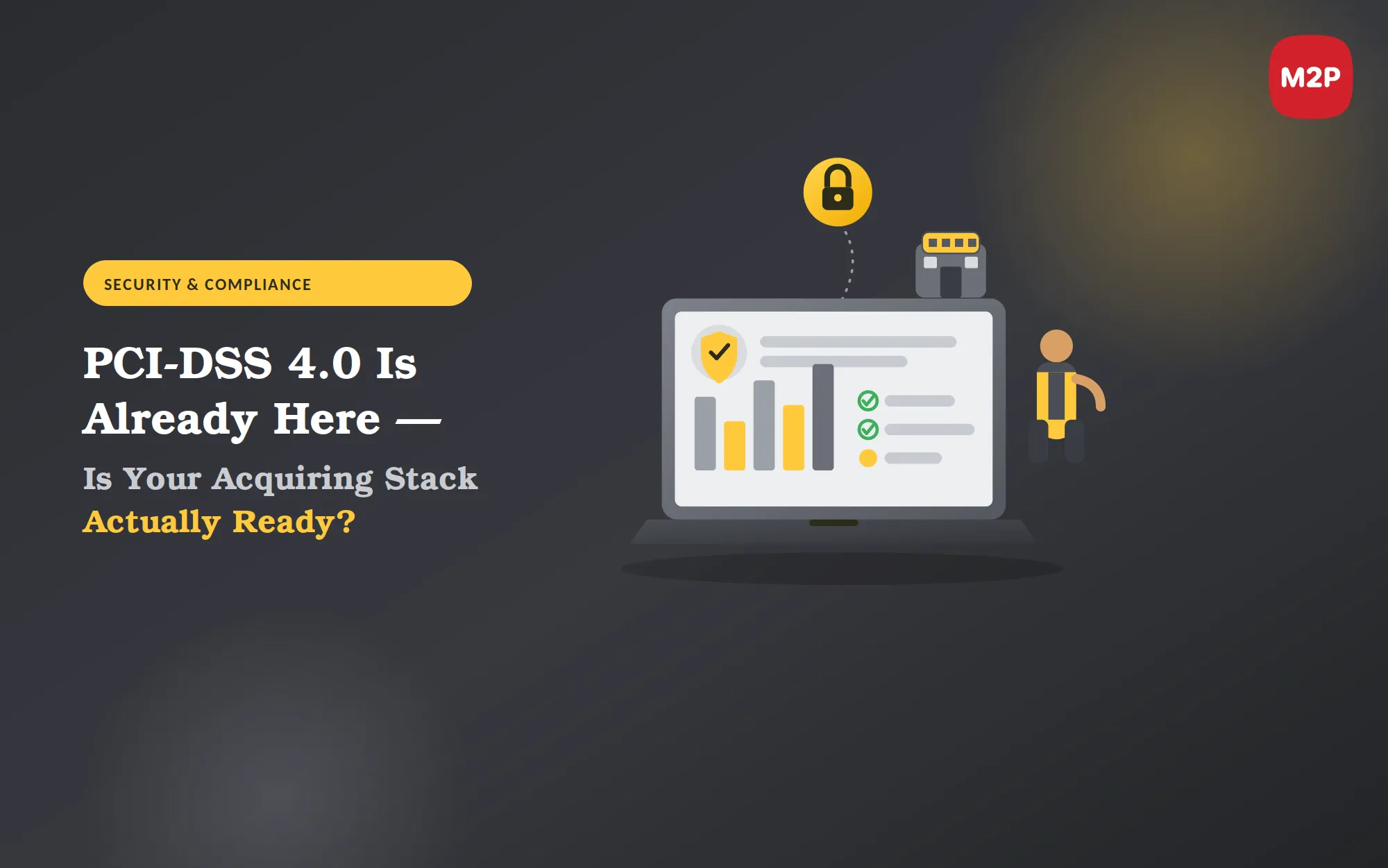
If you've spent any time in payments over the last two years, you've heard the acronym everywhere: PCI-DSS 4.0. For acquirers and Merchant Management System (MMS) providers, this isn't just another compliance checkbox to tick off — it's a fundamental shift in how card data security is designed, implemented, and proven, with direct consequences for merchant onboarding, technology architecture, and the pace at which new payment products can be launched.
With the original PCI-DSS 4.0 deadline of March 2024 behind us, and the final set of "future-dated" requirements becoming mandatory from March 31, 2025, most acquirers and MMS providers are now deep in implementation — or, in some cases, playing catch-up. This blog breaks down what's actually changed, why it matters more for acquirers and MMS providers than for a typical merchant, and how to think about compliance as a competitive advantage rather than a cost center.
PCI-DSS has been updated before — 3.0, 3.1, 3.2, 3.2.1 — but those were largely incremental. PCI-DSS 4.0, released by the PCI Security Standards Council, is different in scope and philosophy. It represents the first major overhaul of the standard in nearly a decade, and it was built around three explicit goals:
Continue meeting the security needs of the payments industry as threats evolve — particularly around e-skimming, API-based attacks, and cloud-native infrastructure that didn't exist when PCI-DSS 3.2.1 was written.
Promote security as a continuous process, not a once-a-year audit exercise.
Add flexibility for organizations using different methods to achieve security objectives — most notably through the new "customized approach" to meeting requirements.
For acquirers and MMS providers specifically, this matters more than it does for a single merchant, because you're not managing one card-data environment (CDE) — you're managing (or enabling) card-data environments across potentially thousands of merchants, each with different risk profiles, integration methods, and technical maturity. A change in how PCI-DSS defines scope, authentication, or monitoring doesn't just affect your own infrastructure; it cascades into how you validate, support, and onboard every merchant on your platform.
Under PCI-DSS 3.2.1, MFA was required primarily for remote access and administrative access to the cardholder data environment. PCI-DSS 4.0 (Requirement 8.4.2) extends this significantly: MFA is now required for all access into the CDE, not just remote or administrative access — including access by employees, contractors, and third parties from within the internal network.
For an acquirer or MMS provider, this means every internal system touching merchant transaction data, settlement records, or card data — from customer support dashboards to internal risk-monitoring tools to developer access on staging environments — needs MFA enforcement, not just the systems your compliance team originally scoped for it.
Minimum password length has increased from seven to twelve characters (Requirement 8.3.6), and passwords must now include both numeric and alphabetic characters. At the same time, PCI-DSS 4.0 allows for alternative authentication mechanisms that meet an equivalent security bar — a nod to the standard's broader "customized approach" philosophy.
For acquirers managing merchant-facing portals and dashboards, this requires an audit of every authentication touchpoint — merchant login portals, internal admin consoles, API key management systems — to ensure password policies actually meet the new bar, not just internal IT systems.
One of the more nuanced changes is the shift from rigid, prescribed frequencies for certain security activities (e.g., "quarterly," "annually") to a framework where organizations can define their own frequency for specific requirements, provided they can justify it through a targeted risk analysis (Requirement 12.3.1).
This sounds like it reduces burden, but in practice it shifts the burden from "do the task on schedule" to "prove, with a documented risk analysis, that your chosen schedule is defensible." For an MMS provider managing security processes across a large merchant portfolio, this means building (and maintaining) risk analysis documentation that a QSA (Qualified Security Assessor) can actually validate — not just picking a convenient interval and hoping it holds up in an audit.
Given the rise in e-skimming attacks (malicious JavaScript injected into payment pages to steal card data at the point of entry), PCI-DSS 4.0 introduces two requirements specifically targeting this vector:
Requirement 6.4.3: All payment page scripts that are loaded and executed in the consumer's browser must be managed — inventoried, justified for business need, and monitored for unauthorized changes.
Requirement 11.6.1: A change and tamper-detection mechanism must be deployed to alert on unauthorized modifications to HTTP headers and the content of payment pages, with alerts at least weekly.
For acquirers and MMS providers who process card-not-present transactions — the majority of e-commerce merchant volume today — this is one of the most operationally demanding new requirements. It requires script inventory management and integrity monitoring across every merchant's payment page, which for a platform serving thousands of merchants means building this as a managed, scalable service rather than a manual, merchant-by-merchant exercise.
PCI-DSS 4.0 formally recognizes that not all MFA is equally secure — SMS-based OTPs, for instance, are vulnerable to SIM-swapping and interception in ways that hardware security keys or authenticator apps are not. While not universally mandated, the standard's emphasis on phishing-resistant authentication methods for higher-risk access points signals where the bar is heading, and acquirers building for the next several years of compliance should architect toward this now rather than retrofitting later.
PCI-DSS 4.0 was explicitly designed with modern infrastructure in mind — containerized deployments, microservices architectures, and cloud-native environments that barely existed in a meaningful way when 3.2.1 was written. This matters enormously for MMS providers, most of whom have built (or are building) their platforms on exactly this kind of infrastructure to achieve the speed and scalability that differentiates a modern acquiring stack from a legacy one.
The updated standard requires clearer scoping methodology for these environments — understanding which containers, services, and cloud components touch cardholder data even transiently, and ensuring segmentation controls are validated in environments where infrastructure can spin up and down dynamically. Acquirers running on legacy, static infrastructure may find this section easier to interpret but harder to justify avoiding modernization; MMS providers on cloud-native stacks get more precise scoping tools, but need to invest in continuous compliance validation rather than point-in-time audits.
Perhaps the most philosophically significant change in PCI-DSS 4.0 is the introduction of the customized approach as an alternative to the traditional "defined approach" for meeting many requirements. Instead of following the prescribed control exactly as written, organizations can design and implement their own control, provided they can demonstrate — through rigorous documentation and testing — that it meets the underlying security objective just as effectively.
This is a meaningful opportunity for MMS providers with genuinely sophisticated security engineering capability: it allows compliance architecture to be built around how your platform actually works, rather than forcing your architecture to conform to a one-size-fits-all control. But it comes with a real cost — customized approach validation requires significantly more documentation, a formal risk analysis for each customized control, and a QSA with the expertise to assess it properly. For most acquirers and MMS providers, the defined approach remains the practical default, with the customized approach reserved for specific areas where platform architecture genuinely diverges from what the standard's prescribed controls assume.
A single merchant needs to secure one, reasonably well-understood card data environment. An acquirer or MMS provider is, in effect, responsible for the compliance posture of an entire ecosystem — sometimes directly (as a service provider validating its own infrastructure), and sometimes indirectly (by enabling and supporting merchant compliance across a diverse portfolio).
This creates a few distinct pressures:
Portfolio-wide scope complexity. Every merchant integration method — hosted payment pages, direct API integration, SDK-based mobile acceptance, POS terminal integration — creates a different PCI-DSS scoping boundary. An MMS provider supporting all of these needs a scoping methodology sophisticated enough to correctly classify each merchant's environment, not a single blanket policy.
Service provider-level validation requirements. As a Level 1 service provider (the classification acquirers and MMS platforms typically fall under), the validation bar is the highest in the standard — a full Report on Compliance (RoC) by a QSA, not a Self-Assessment Questionnaire (SAQ). This means every one of the changes above needs to be demonstrably implemented and evidenced, not just self-attested.
Merchant enablement responsibility. Many merchants — particularly SMEs — rely heavily on their acquirer or MMS provider's platform to inherit compliance rather than build it themselves (for instance, through PCI-compliant hosted payment pages that keep the merchant largely out of PCI scope). This means the acquirer's own compliance posture directly determines how much compliance burden merchants face — a genuine differentiator in a market where merchants increasingly choose acquiring partners based on how little compliance work they have to do themselves.
Continuous compliance, not annual compliance. PCI-DSS 4.0's emphasis on continuous monitoring (script integrity checks, targeted risk analyses, ongoing vulnerability management) means the old model of "get audited once a year and move on" no longer holds. Acquirers and MMS providers need compliance to be an operational capability embedded in the platform, not a periodic project.
1. Run a gap assessment against the full 4.0 requirement set — not just the future-dated ones. Many organizations focused their initial 4.0 efforts on the requirements that became mandatory in March 2024, then treated the March 2025 future-dated requirements as a separate, later project. By now, both sets are in effect, and a genuine gap assessment across the complete standard is essential if this hasn't already been done comprehensively.
2. Prioritize e-commerce script and tamper-detection requirements early. Given how operationally intensive Requirements 6.4.3 and 11.6.1 are to implement at scale across a merchant portfolio, these deserve early, dedicated engineering investment rather than being treated as a checkbox exercise near an audit deadline.
3. Build MFA and authentication controls as platform-wide, not system-by-system. Given how broadly Requirement 8.4.2 now applies, retrofitting MFA system-by-system as gaps are discovered is inefficient. A platform-wide identity and access management approach, applied consistently across every system touching the CDE, is far more defensible in an audit and far less operationally painful to maintain.
4. Treat targeted risk analyses as a genuine documentation discipline, not a formality. If you're using the flexibility PCI-DSS 4.0 offers around setting your own frequencies for certain controls, invest in rigorous, well-documented risk analysis methodology. A QSA will test whether your reasoning holds up — and weak documentation here is one of the more common reasons organizations fail this part of an assessment.
5. Evaluate whether the customized approach is worth pursuing for any specific control. For most organizations, it isn't — the documentation and validation overhead is substantial. But for specific areas where your platform's architecture is genuinely more advanced than what the defined approach assumes, it can be worth the investment, particularly if it removes friction elsewhere in your compliance program.
6. Make merchant compliance enablement part of your product roadmap, not just your legal team's remit. The acquirers and MMS providers who will win merchant loyalty over the next several years are the ones who treat PCI-DSS 4.0 as an opportunity to reduce merchant compliance burden — through compliant hosted payment pages, tokenization, and pre-validated integration methods — rather than simply passing the compliance requirement down to merchants unchanged.
It's tempting to view PCI-DSS 4.0 purely as a cost of doing business — another set of controls to implement, document, and prove. But for acquirers and MMS providers, compliance posture is increasingly a genuine point of competitive differentiation. Merchants evaluating acquiring partners are asking sharper questions than they used to: How much of the PCI burden do you take off my plate? How quickly can I integrate in a way that keeps me out of scope? How resilient is your platform against the e-skimming and API-based attacks that keep showing up in breach reports?
An acquirer or MMS provider that has built PCI-DSS 4.0 compliance deeply into its platform architecture — rather than bolting it on as a parallel compliance project — can answer these questions convincingly, turning what looks like a regulatory burden into a genuine merchant acquisition and retention advantage.
Navigating PCI-DSS 4.0 doesn't need to mean slowing down your acquiring business or diverting your engineering roadmap for a year. M2P's Merchant Management System is built with modern, continuously validated security architecture at its core — from platform-wide authentication controls to merchant onboarding flows designed to minimize PCI scope from day one — so banks, NBFCs, and PSPs can meet the highest compliance bar without sacrificing the speed and merchant experience that keeps them competitive.
Explore M2P's MMS to see how compliance-ready infrastructure can power your acquiring business — reach out to M2P today.
Tags

Fintech is evolving every day. That's why you need our newsletter! Get the latest fintech news, views, insights, directly to your inbox every fortnight for FREE!