

M2P Fintech
Fintech is evolving every day. That's why you need our newsletter! Get the latest fintech news, views, insights, directly to your inbox every fortnight for FREE!
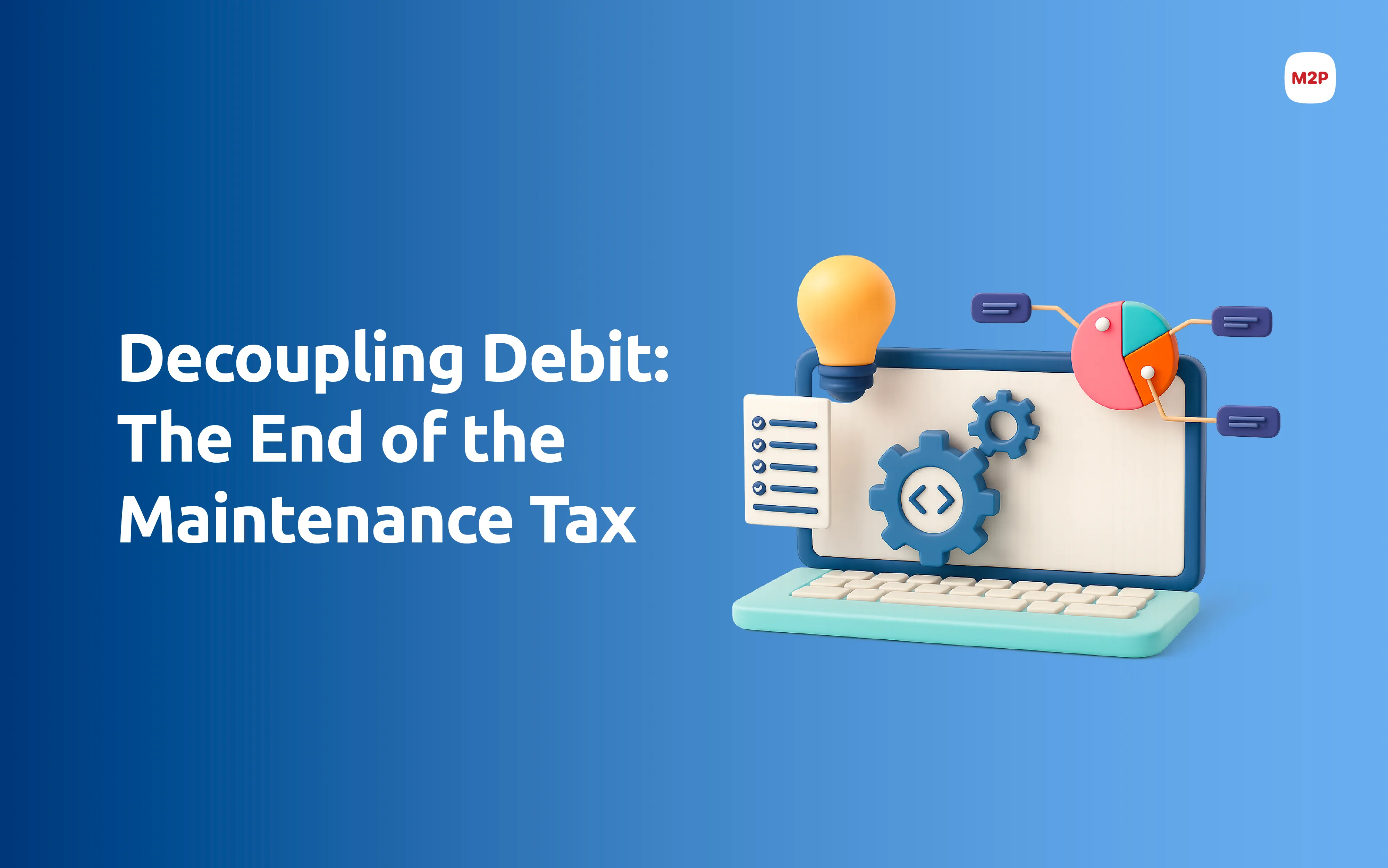
In the rapidly evolving landscape of financial technology, banks are constantly seeking ways to innovate, enhance customer experience, and reduce operational overhead. One of the most significant, yet often unseen, burdens on traditional financial institutions is the "maintenance tax" – the substantial cost and effort required to maintain legacy core banking systems. This tax isn't a direct fee to customers, but an internal drain on resources that stifles innovation and agility. A key area where this maintenance tax is particularly burdensome is in the management of debit cards. As a result, a growing number of modern banks are now choosing to decouple their debit card infrastructure from their core systems. This strategic shift is not just a technical upgrade; it's a fundamental rethinking of how banking services can be delivered in the digital age.
The term maintenance tax in banking refers to the immense operational and financial costs associated with maintaining outdated, monolithic core banking systems. These legacy systems, often built decades ago, are the bedrock of a bank's operations, handling everything from account management to transaction processing. However, their rigid, inflexible architecture makes them a significant impediment to progress.
Every new product launch, every regulatory update, and every attempt to integrate with modern fintech solutions requires complex, time-consuming, and expensive modifications to the core. This constant cycle of patching and workarounds consumes a significant portion of a bank's IT budget, diverting resources that could be better invested in innovation and improving customer-facing services. This is the maintenance tax in action – a hidden cost that holds banks back from competing effectively with agile, digital-native competitors.
Debit cards, while a ubiquitous and essential banking product, present a unique set of challenges when tightly integrated with legacy core systems. The modern customer expects a seamless, digital-first experience with features like instant card issuance, real-time transaction notifications, and granular spending controls. However, delivering these features on a legacy core is often a struggle.
The batch-processing nature of many older systems means that updates are not reflected in real-time, leading to a disjointed customer experience.
Furthermore, the monolithic nature of these systems makes it difficult to innovate rapidly. Launching a new card program or partnering with a third-party to offer value-added services can take months, if not years, of development work. In a market where speed and agility are paramount, this is a significant competitive disadvantage.
To escape the burden of the maintenance tax and meet the demands of modern consumers, banks are increasingly turning to a new architectural approach: decoupling their debit card systems from the core. Decoupling involves separating the card management and transaction processing functions from the core banking system, allowing for a more flexible, modular, and API-driven approach.
This separation allows banks to leverage modern, cloud-native platforms that are specifically designed for the intricacies of card issuance and management. These platforms can be integrated with the core banking system for essential functions like account balance verification, but they operate independently for all other card-related activities.
The benefits of this approach are numerous:
Increased Agility and Faster Time-to-Market: By leveraging a modular, API-first platform, banks can launch new card products and features in a fraction of the time it would take with a legacy core. This allows them to respond quickly to market trends and changing customer expectations.
Reduced Operational Costs: Modern card platforms are often more efficient and cost-effective to operate than legacy systems, reducing the total cost of ownership (TCO). The pay-as-you-go models of many cloud-native solutions also allow banks to scale their costs in line with their business growth.
Enhanced Customer Experience: Decoupling enables a host of modern features that are difficult to implement on legacy cores, such as instant digital card issuance, real-time transaction alerts, and sophisticated card controls. This leads to a more engaging and satisfying customer experience.
Improved Scalability and Resilience: Cloud-native platforms are designed to handle fluctuations in transaction volumes, ensuring that the system remains stable and responsive even during peak periods. The microservices architecture of these platforms also improves resilience, as an issue with one component does not impact the entire system.
Future-Proofing the Infrastructure: By moving to a modern, modular architecture, banks can future-proof their debit card business. They are no longer locked into a single vendor or technology stack and can easily integrate with new partners and technologies as they emerge.
For many banks, the transition to a decoupled architecture is best achieved in partnership with a specialized Technology Service Provider (TSP). TSPs are external firms that offer technology solutions and expertise to financial institutions.
They play a pivotal role in the modernization of the banking sector, providing everything from core banking platforms to payment processing and cybersecurity services.
In the context of debit card decoupling, a TSP can provide a pre-built, fully managed card issuance and processing platform. This allows banks to offload the technical complexity of building and maintaining their own system, enabling them to focus on their core business of serving customers. A good TSP will offer a platform that is not only technologically advanced but also compliant with all relevant regulations and security standards.
For banks looking to innovate, partnering with a TSP that provides a flexible and robust debit card stack can be a game-changer. It allows them to tap into a wealth of expertise and a pre-built ecosystem of integrations, dramatically accelerating their digital transformation journey.
For banks looking to make the leap to a decoupled debit card architecture, the M2P Debit Card Stack offers a compelling solution. As a leading TSP, M2P provides a unified platform that simplifies the entire card lifecycle, from issuance and processing to monitoring and risk management.
The platform's API-first, modular architecture allows for seamless integration with existing core banking systems while providing the flexibility to innovate at speed. Banks can launch new physical, virtual, or tokenized card programs in weeks, not months, and offer their customers a truly modern, digital-first experience. With features like SuperPIN, dynamic CVV, and location-based security, the M2P stack also provides robust fraud prevention capabilities, giving both the bank and its customers peace of mind.
By leveraging a solution like the M2P Debit Card Stack, banks can effectively eliminate the maintenance tax associated with their legacy debit card systems. They can reduce their TCO, improve operational efficiency, and, most importantly, deliver the kind of innovative and responsive service that modern customers demand.
The maintenance tax is a significant and growing burden on traditional banks. It stifles innovation, drains resources, and makes it difficult to compete in an increasingly digital world. By decoupling their debit card systems from their legacy cores, banks can break free from this tax and embrace a more agile, modern, and customer-centric approach. This strategic shift, often undertaken in partnership with a knowledgeable TSP, is not just about upgrading technology; it's about fundamentally transforming the business of banking for the better. The future of debit is decoupled, and the banks that embrace this change will be the ones that thrive in the years to come.
The next wave of banking growth won’t come from maintaining legacy cores. It’s being built on modern, decoupled stacks - talk to us today and see what powers it.
Follow us on LinkedIn and Twitter for insightful fintech bytes curated for curious minds like you.
Fintech is evolving every day. That's why you need our newsletter! Get the latest fintech news, views, insights, directly to your inbox every fortnight for FREE!